- The balance: same operation on BOTH sides, always — or it lies.
- Gather x's on one side, numbers on the other, then divide by the coefficient.
- "Change sides, change sign" is the shorthand — legal ONLY as the balance's echo (subtract-from-both, abbreviated).
Isolating x Without Breaking Anything
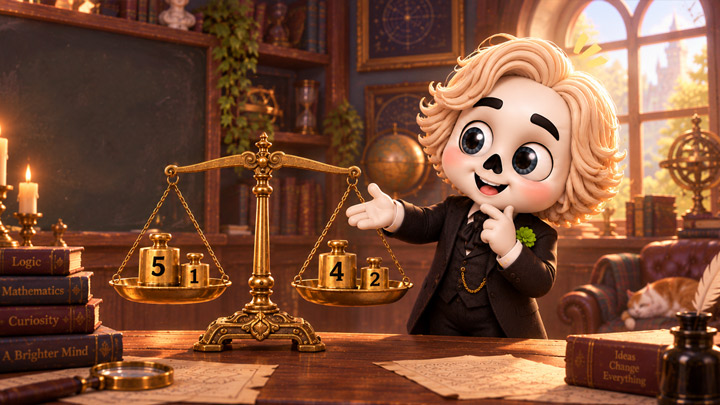
Year 8 met the balance; this year masters it and names its shortcut. An EQUATION is a BALANCE with two pans, and one image governs everything: whatever you do to one side, you do to the OTHER — add, subtract, multiply, divide, identically, or the balance lies. Solving 5x = 2x + 12: gather the x's on one side (subtract 2x from both — the balance holds), 3x = 12, then divide both by 3, x = 4. The trade's shorthand, understood not memorised: CHANGE SIDES, CHANGE SIGN — moving 2x across the equals flips its sign (+2x becomes −2x), because "subtract 2x from both sides" IS that move, abbreviated; the shortcut is legal ONLY as the balance's echo, never a rule on its own. Two disciplines close the chapter: VERIFY IN THE ORIGINAL (the one judge that can't be corrupted by your own arithmetic — put x = 4 back into 5x = 2x + 12: 20 = 20 ✓), and NAME THE UNKNOWN when solving word problems ("let x be the number…", the line that turns a story into an equation). The arrival is whatever it is — negative, fraction, zero: solutions aren't judged on looks.
The Method
| The Step | The Move | On 5x = 2x + 12 | The Law |
|---|---|---|---|
| The balance | Same operation BOTH sides | — | Or the balance lies |
| Gather the x's | Subtract 2x from both | 3x = 12 | "Change sides, change sign" — the echo |
| Isolate x | Divide both by 3 | x = 4 | The factor's opposite operation |
| The shorthand | Cross the equals, flip the sign | +2x → −2x | Legal only as the balance's abbreviation |
| Verify | Back in the ORIGINAL | 5×4 = 20, 2×4+12 = 20 ✓ | The incorruptible judge |
| Name the unknown | "Let x be…" | Story → equation | The line that starts the solution |
5x = 2x + 12. x = ?
Gather the x's: 5x − 2x = 12, so 3x = 12, x = 4. Verify: 20 = 20 ✓. The 6 divided 12 by 2 (the wrong number); the 12 ignored the 2x entirely. Change sides, change sign: the +2x crosses as −2x, the balance's echo — and the check confirms.
The Shorthand as Echo, the Incorruptible Judge
The shorthand decoded: 5x = 2x + 12 → 5x − 2x = 12 — the "+2x" that crossed the equals came back as "−2x", and this is not magic: it's "subtract 2x from BOTH sides" written short (on the left, 2x − 2x = 0; on the right, +2x − 2x cancels the crossing term). The shortcut works because the balance works; forget the balance and the shortcut becomes a superstition that occasionally misfires.Verification, the one judge you can't bribe: your own solving can carry a hidden slip, but substituting x back into the ORIGINAL equation tests it against untouched ground — x = 4 in 5x = 2x + 12 gives 20 = 20 ✓. Verifying in a LINE YOU derived (a middle step) can inherit your error; only the original is incorruptible. Ten seconds, and the answer is armoured — or the slip confesses.
The Drowned Sign — and the Corrupted Judge

Solving 5x = 2x + 12, a student writes 5x + 2x = 12. The error?
Change sides, change SIGN: the +2x crosses as −2x, so 5x − 2x = 12, not 5x + 2x. The drowned sign gives 7x = 12 (wrong: x ≈ 1.7 fails the check). The shorthand is "subtract 2x from both sides" abbreviated — the flip is the echo of that subtraction, never optional.
Case File: The Disputed Wage


- The balance: same operation on BOTH sides, always — or it lies.
- Gather x's on one side, numbers on the other, then divide by the coefficient.
- "Change sides, change sign" is the shorthand — legal ONLY as the balance's echo (subtract-from-both, abbreviated).
- VERIFY in the ORIGINAL equation (the incorruptible judge) — never a line you derived.
- NAME the unknown ("let x be…") — the line that turns a story into an equation ; looks don't judge the answer.