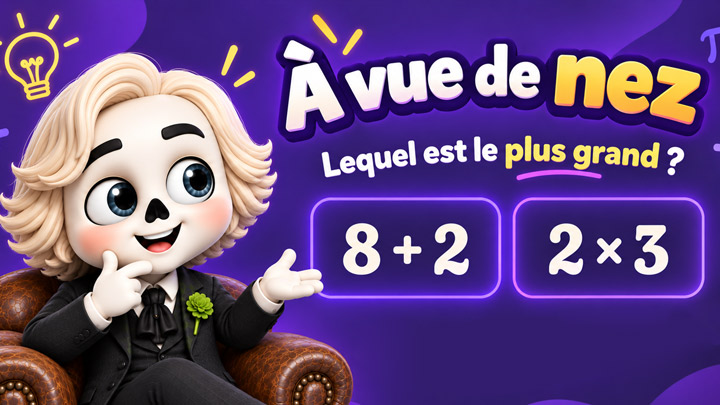
- Every digit is worth its PLACE: tenths, hundredths, thousandths — mirrors of tens, hundreds, thousands.
- Compare: whole parts first, then EQUALIZE lengths (free trailing zeros) and read the places.
- "Longer means bigger" is THE mistake: 2.5 beats 2.45.
Place Value on Both Sides of the Point
A DECIMAL number has two territories split by the decimal point: the WHOLE part on the left, the DECIMAL part on the right — and every digit draws its value from its PLACE: in 247.358, the 2 is two hundreds, the 7 seven units, the 3 three TENTHS, the 5 five HUNDREDTHS, the 8 eight THOUSANDTHS. The mirrored names are no accident: tens/tenths, hundreds/hundredths — each place on the right mirrors one on the left, ten times smaller per step. Hence the learned reading: 247.358 = 247 + 3/10 + 5/100 + 8/1000 — a decimal is a sum of decimal fractions in disguise, the bridge to the fractions lesson. Golden rule straight away: TRAILING zeros weigh nothing — 2.5 = 2.50 = 2.500; but 2.5 and 2.05 are different numbers: the SANDWICHED zero works for a living.
The Place-Value Table
| The Place | Its Value | In 247.358 | The Mirror |
|---|---|---|---|
| Hundreds | 100 | the 2: two hundred | faces the hundredths |
| Tens | 10 | the 4: forty | faces the tenths |
| Units | 1 | the 7: seven | the pivot, glued to the point |
| Tenths | 1/10 = 0.1 | the 3: three tenths | first place after the point |
| Hundredths | 1/100 = 0.01 | the 5: five hundredths | the place of cents |
| Thousandths | 1/1000 = 0.001 | the 8: eight thousandths | the place of grams in a kilo |
In 63.472, the hundredths digit is…
Decimal places count from the point: the 4 holds the TENTHS (first place), the 7 the HUNDREDTHS (second), the 2 the thousandths. "The digit of…" asks for ONE digit, never a chunk of number.
Comparing and Ordering
To compare decimals: WHOLE parts first (13.9 beats 12.999, no contest); with equal whole parts, compare place by place — and the master trick EQUALIZES lengths with free trailing zeros: for 3.7 versus 3.52, write 3.70 against 3.52 — seventy hundredths against fifty-two: 3.7 wins. The ear that heard "52 beats 7" is overruled by the places.Multiplying or dividing by 10, 100, 1000 MOVES the point: ×10 pushes it one place right (4.25 → 42.5), ÷100 two places left (37 → 0.37). That is the engine of unit conversions: 3.5 m = 350 cm, 1250 g = 1.250 kg — the point travels, the digits never move.
The "Longer Means Bigger" Trap

Order from smallest to largest: 5.3 — 5.08 — 5.275:
Equalize: 5.300 — 5.080 — 5.275, and the places decide: 080, 275, 300. "Longer means bigger" would crown 5.275 — length is typography, places are truth.
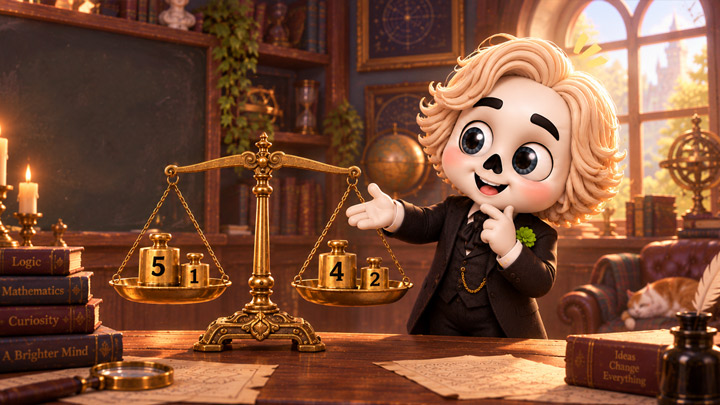
Case File: The Cellar Scales


- Every digit is worth its PLACE: tenths, hundredths, thousandths — mirrors of tens, hundreds, thousands.
- Compare: whole parts first, then EQUALIZE lengths (free trailing zeros) and read the places.
- "Longer means bigger" is THE mistake: 2.5 beats 2.45.
- Trailing zero: weightless (2.5 = 2.50). Sandwiched zero: holds its place (3.05 is not 3.5).
- ×10, ×100, ×1000: the point travels right; ÷: left — digits never move.